
Beginner cellists, Folk Music, Free Sheet Music, Intermediate Cellists, Pop Music
First published on Mar 14, 2026 by Seb
Last updated on Mar 15, 2026 by Seb
Sarah McLachlan’s “Angel”, released in 1997 on the album Surfacing, mesmerized a generation of listeners and remained on major Billboard charts for extended periods. It was originally recorded in D-flat major, but McLachlan has since performed it in D major, including during her 2004 Afterglow tour, where she accompanied herself on piano without the drum machine elements from the original release.
This 2004 vocal-piano version has now been recomposed into a self-accompanied cello piece in F major, a transposition chosen to take advantage of the cello’s open strings. Unlike past recompositions of popular music at Project BachWroteWhat that bury the source material as hidden easter eggs, the original melody of “Angel” comes through clearly throughout.
First, let’s hear the original from Sarah herself:
As usual, this recomposer asks to be forgiven for his amateurish rendering of this piece. He invites real cellists to record this music as replacements for makeshift recordings currently shown below.
Find below sheet music, with annotations by the recomposer on his own approach to playing this piece as an amateur cellist himself. Notes are slurred with suggested bowings. The recomposer also marked fingering positions suitable for an intermediate cellist. But you can, and probably should make your own annotations. Clean sheets with just notes are found further down this post. Following are PNG and PDF versions with annotations.
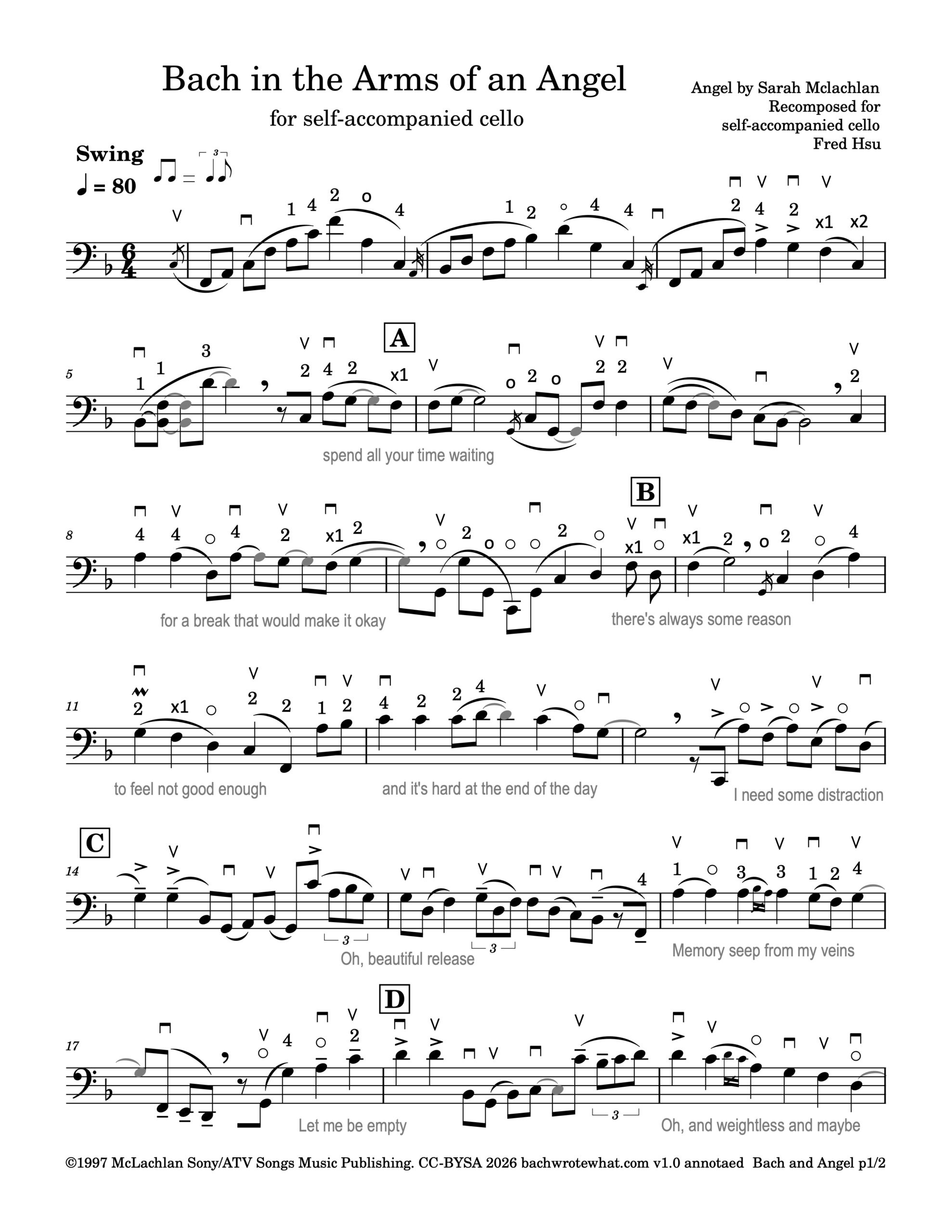
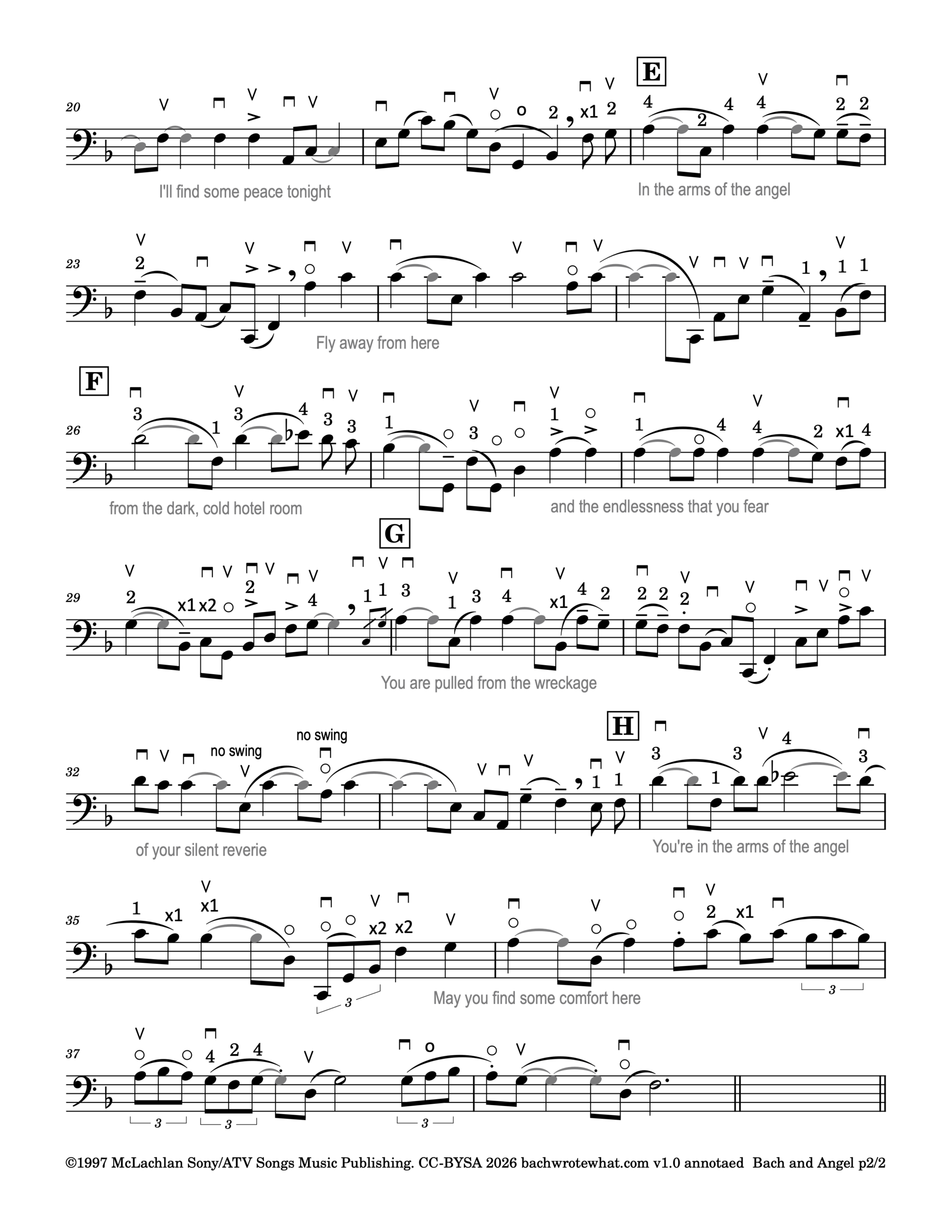
By transposing the original D major down to F major, the arrangement places notes from the melody comfortably on the A, D, and G strings. Memorable passages can be rendered in low positions on the A string with brilliant, projecting power. The open strings A, D, G, and C lend themselves naturally to resonant accompaniment of the main melody. Of all the keys the arranger experimented with, F major proved to be the clear winner.
This piece is to be performed in a swing style, with nearly all eighth notes interpreted accordingly. The degree of swing, however, is left to the cellist’s discretion: how much each pair of eighth notes is stretched and compressed can be decided in the moment.
If you are an advanced cellist, you will want to determine your own slurrings, bowings, and fingerings. Clean sheets with only notes are provided below. Feel free to further adapt this arrangement. Both PNG and PDF versions are available.
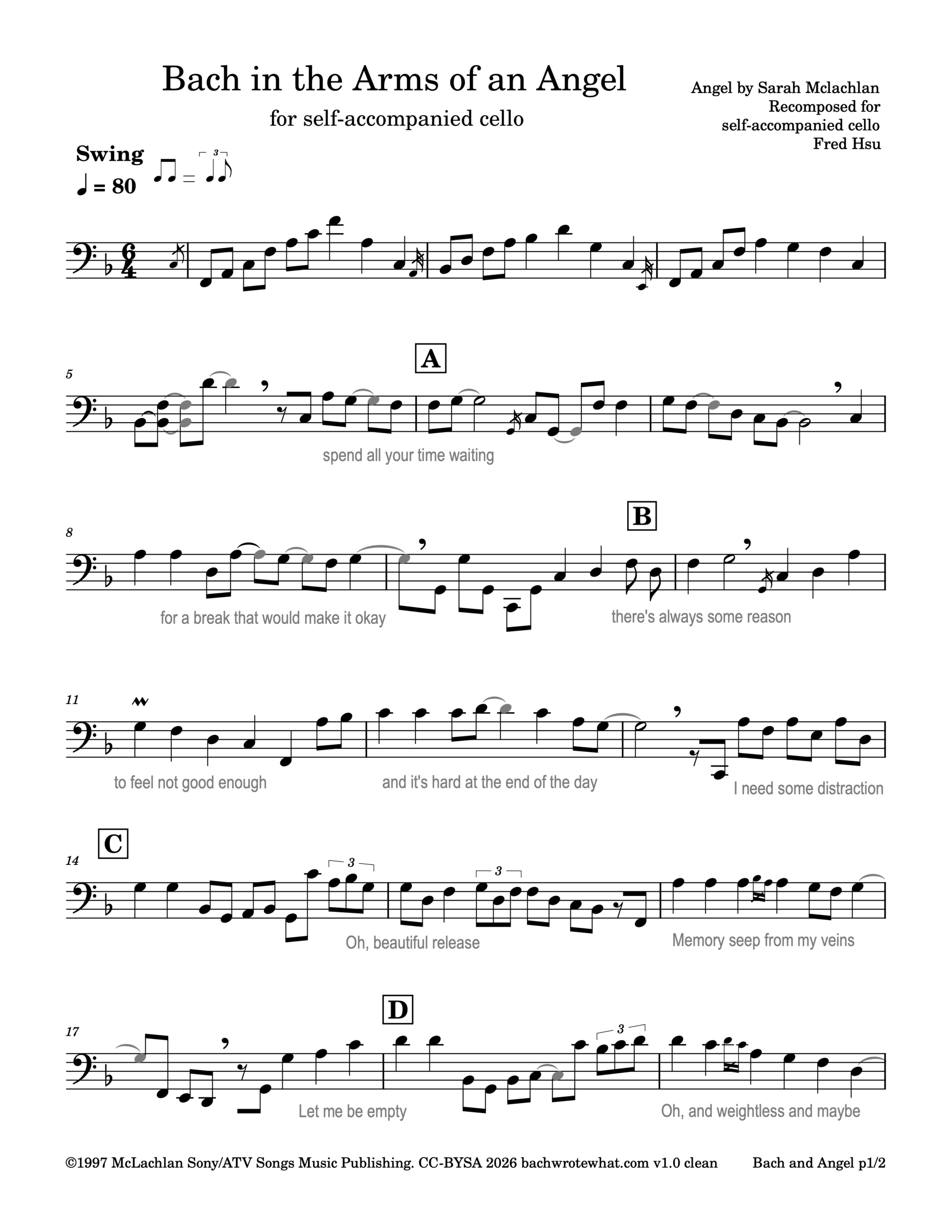
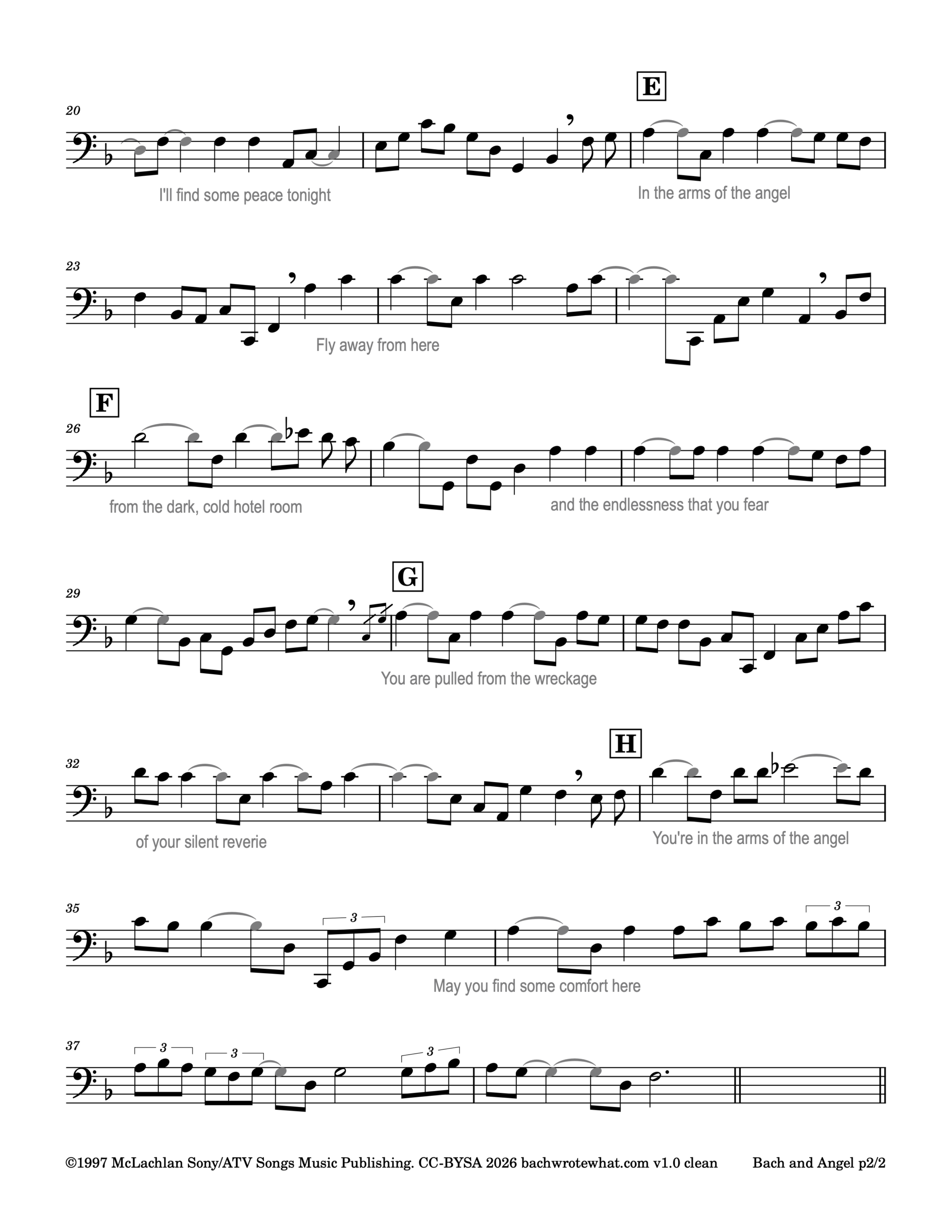
The copyright for Angel belongs to Sarah McLachlan. ©1997 McLachlan Sony/ATV Songs Music Publishing.
While we are not aware of other self-accompanied recompositions, there are plenty of instrumental covers of Angel. Here is the violinist Susan Holloway accompanied by various instruments.
Violinist Rob Landes covers this music with a traditional piano accompaniment.
Fellow Canadians Jonathan Chan and Jan Bislin cover Sarah’s music at a mall. The audio recording was probably made in a studio, as the video shot at a mall doesn’t perfectly match recorded audio.
A melody naturally comes through with greater power when a fiddler can focus single-mindedly on rendering it, leaving harmony and counterpoint to a piano’s fuller capabilities. But at Project BachWroteWhat, we continue to believe there is a place for both Bach Cello Suites and Elgar Cello Concerto.
Sometimes we do envy the guitar with its multi-string and choral capabilities. Here is Marco Tamayo playing his own arrangement of Angel.
Leave a Reply