Baroque, Free Sheet Music, Intermediate Cellists
First published on Aug 22, 2026 by Seb
Last updated on Aug 30, 2026 by Seb
It does seem odd that, for a project named “Bach Wrote What,” we’ve never actually talked about what Bach wrote for self-accompanied cello in the two years since the project began. There are plenty of excuses: “no one knows the true originals,” “nobody agrees on the best fingering and phrasing,” and so on. Perhaps we didn’t want to put up something that might upset a lot of cellists.
But nobody can say that “there is no free sheet music for the cello suites.” The truth is that there is plenty of free sheet music for all six suites. In fact, there is too much, and much of it is incomplete or incorrect. That’s considering just the notes. Once fingering, phrasing, and bowing marks are involved, things become even more complicated, with approaches that are often inconsistent and whose methodology is hidden. Some of these traditions are passed down from teachers to students for generations, each with their own following. But how does anyone know how to compare different versions objectively?
These excuses are no longer valid the moment we stumble upon the sheet music that cellist Ian Swedlund makes available for free at cellofun.eu, covering all six suites. His approach to each suite is documented on its own page, with detailed explanations of his reasoning behind the phrasing, fingering, and bowing for every movement.
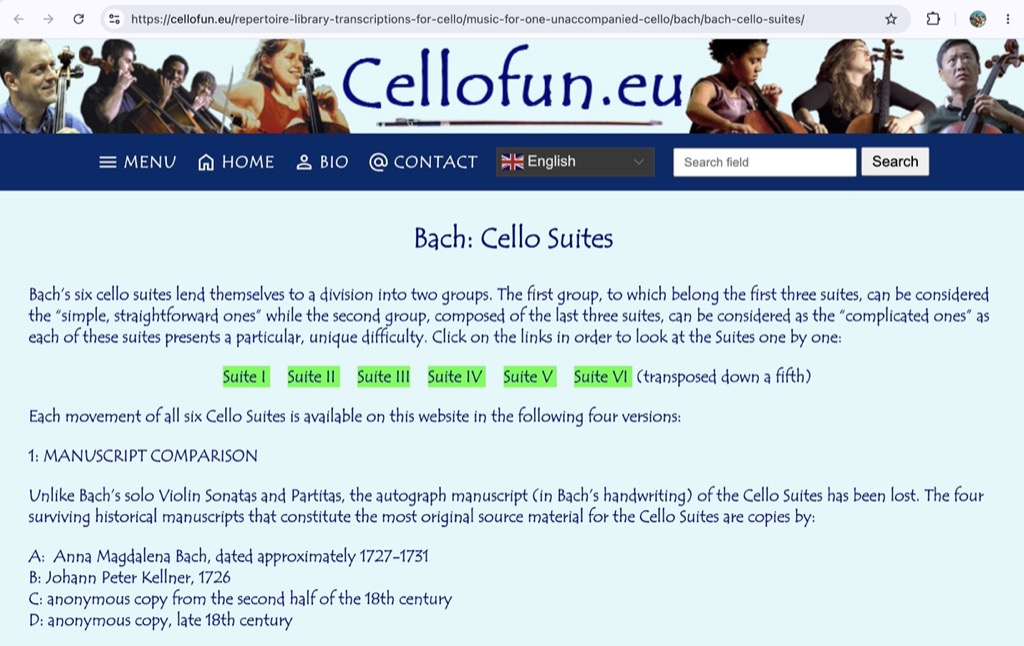
Four PDF files are available for every movement. First, there is a comparison of four manuscripts for analysis: Anna Magdalena Bach, Johann Peter Kellner, an anonymous 18th-century copy, and another anonymous copy from the late 18th century. From an analysis of these four sources, Swedlund produces a clean, notes-only PDF. A two-cello version of the clean notes is also provided, both as a tool for sheer playing pleasure and as a way to study the implied harmonies of the solo line. Finally, a fourth PDF contains Swedlund’s own fingering, phrasing, and bowing marks, based on his lifelong study of the instrument and the music. These markings are consistent with the pedagogical approaches he has articulated in his vast cello writing in the “Celloblog” section of the website.
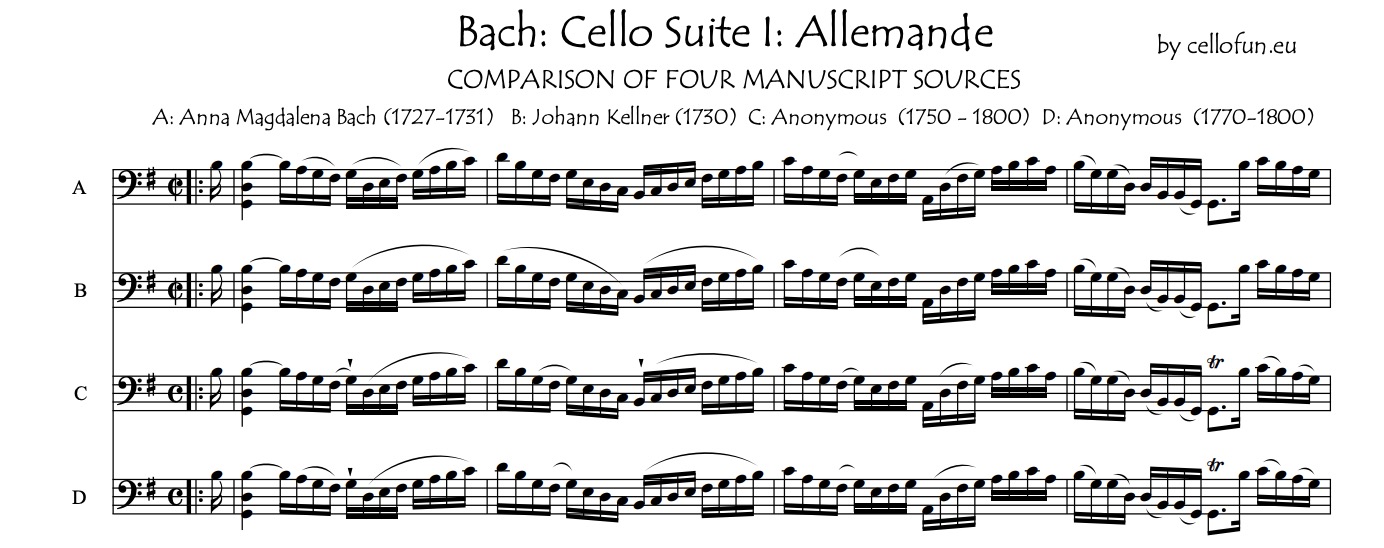
Following is an example of the four-manuscript analysis. It can be seen right away that these manuscripts have very different ideas about phrasing. Swedlund’s philosophy is that there is no single “right” way to play this music. While standing on the shoulders of vintage interpretations, a cellist should make phrasing, bowing, and fingering work for their own pleasure in playing, while also delivering an enjoyable experience to the audience.
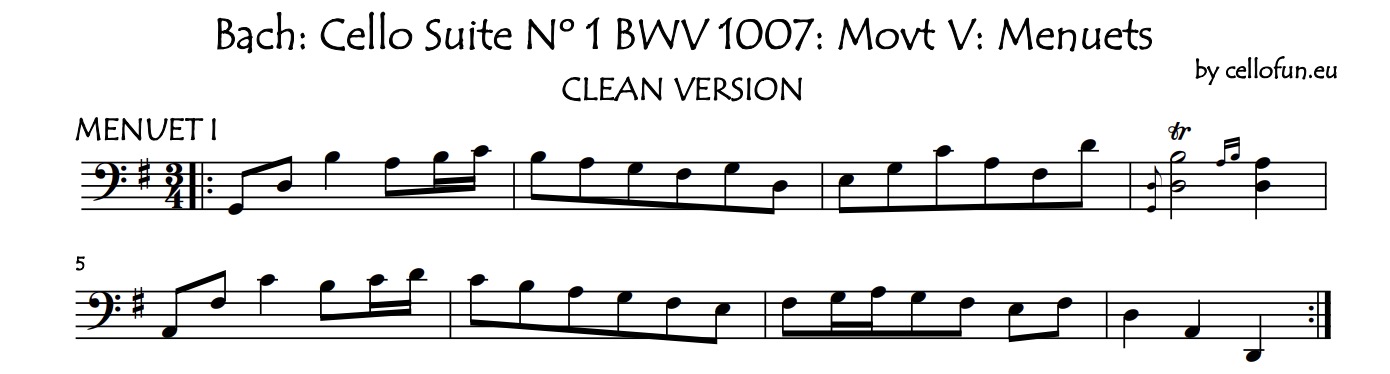
Following is an example of clean, notes-only version.
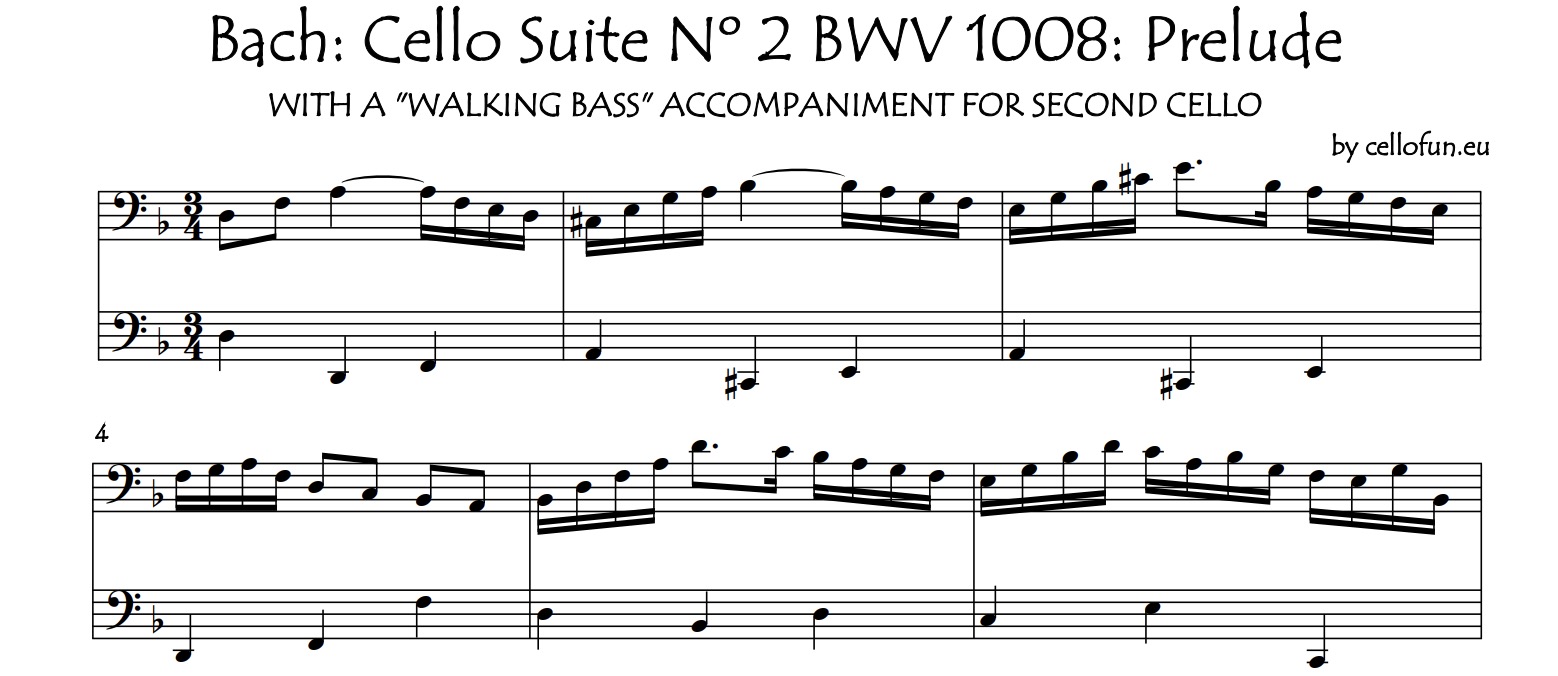
Following is an example of the duo-cello version. Swedlund predominantly adopts the Beatles’ walking-bass-line approach in creating these arrangements.
Finally, following is an example of the performance edition, with Swedlund’s phrasing, bowing, fingering, and dynamics. These “edited” versions are the culmination of his lifelong work. Again, no particular interpretation of Bach’s music is “right.” This is simply one way to play the music. But at last, there is a systematic and internally-consistent approach to all the movements in all six suites.
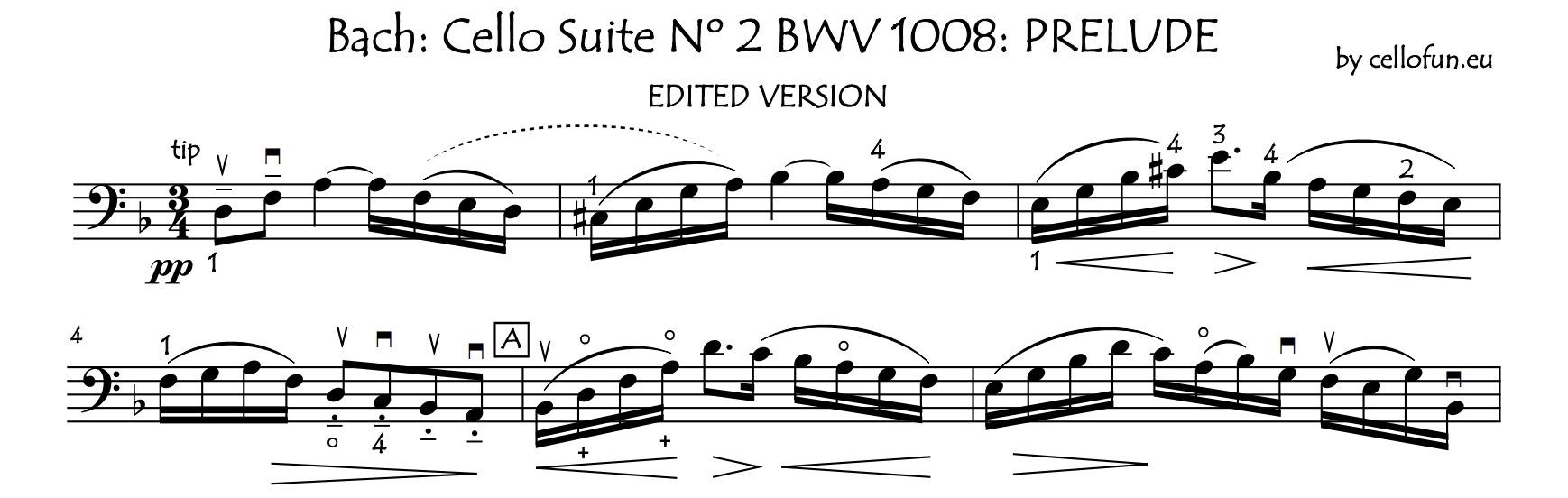
Often, one can discern Swedlund’s principles simply by playing the piece as he has annotated it. For instance, the bowings lend themselves to creating the dynamics indicated in the score. In other words, even if one disregards the dynamic markings, simply following the annotated bowings will naturally produce the indicated dynamics. In the Suite II Prelude above, the dotted slur in bars 1 and 2 indicates one single down bow, while the two solid slurs indicate separate phrases with a musical space between them. Reference the “Choosing Bowings” section in the pedagogical part of the site for more on his approach to bowing. Also see this page for additional unusual annotations including solid brackets, dotted brackets, x noteheads, etc.
Everything on cellofun.eu is free, and there will never be ads on Swedlund’s site. We follow the same principle at bachwrotewhat.com: all music written or arranged by our staff is always available for free, and this site will never host ads.
You can find free sheet music for all 36 movements of Bach’s Cello Suites here:
When you are ready to venture beyond Bach, know that there is much more to this site than the six Cello Suites. Cellofun.eu is like a one-man Wikipedia of the art of cello playing, combined with a repository of solo cello music, both unaccompanied and accompanied.
We have, in fact, already mentioned cellofun.eu in the article The Chaconne in Cello’s Range, where we noted how Swedlund transcribed, transposed, and annotated the entire Bach Solo Violin Partita Nº 2 in D Minor BWV 1004, for cello.
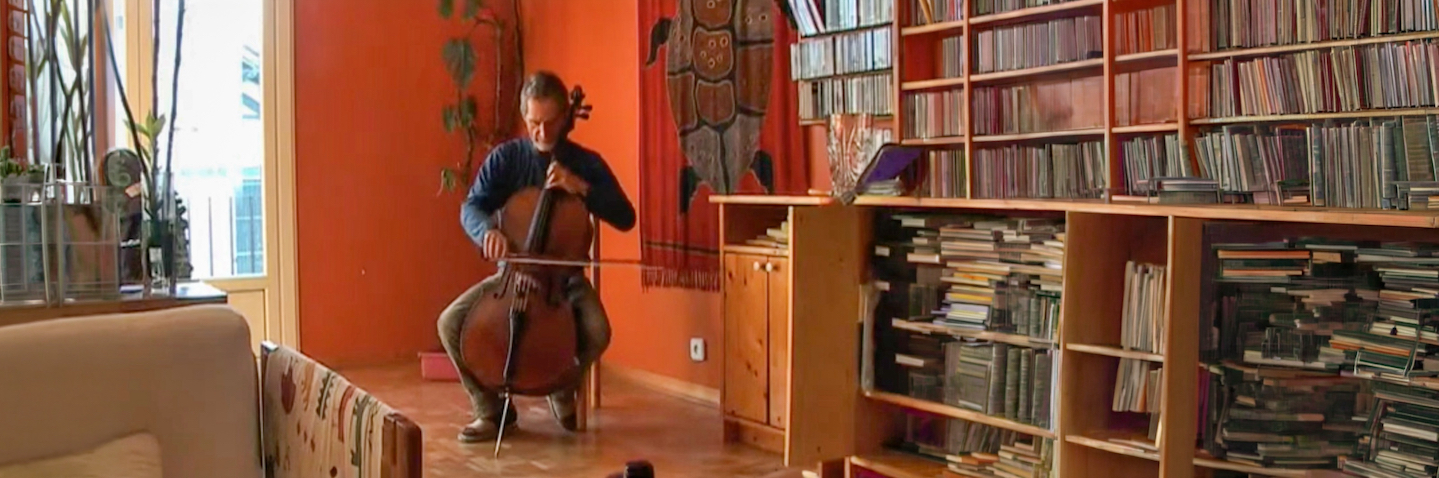
Here is Swedlund playing his arrangement of Sarasate’s Playera, with sheet music.
And this is his arrangement of Zapateado, a Spanish dance, for cello. Again, with free sheet music. But we repeat ourselves.
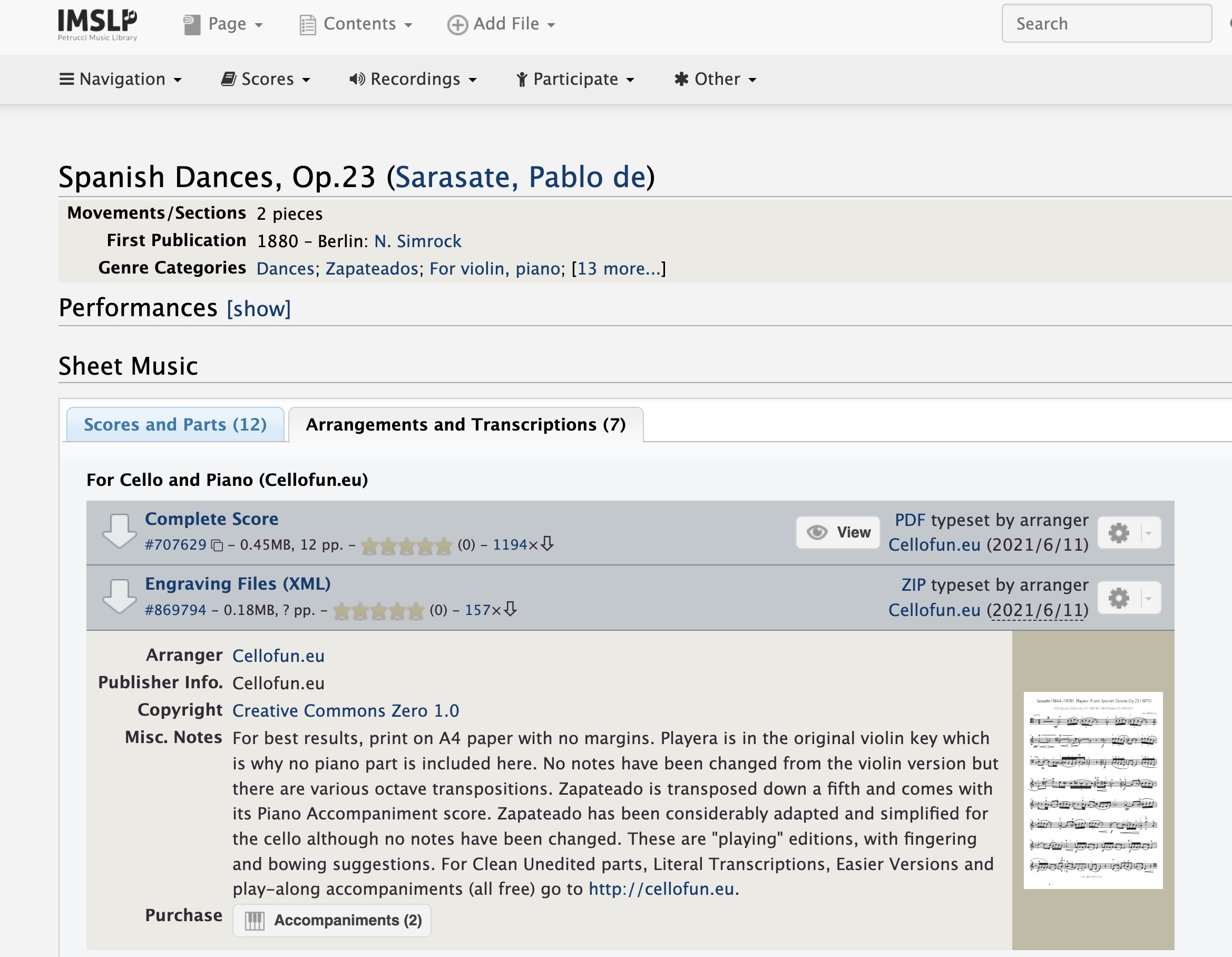
Some of Swedlund’s arrangements are also available on IMSLP, under the “As Arranger” tab. Click on a piece’s link, and you will usually find cellofun.eu listed under the “Arrangements and Transcriptions” tab (like this). Often you will also find an .XML file, which can be imported into MuseScore and similar notation software. The Bach cello solo .XML files are under the “As Editor” tab, for all suites, except for suite II – you will find them at the bottom of this cellofun.eu page.
We mentioned Johnstone and his free cello-music repertoire in the article Fantasy on Yesterday by David Johnstone. Johnstone himself highly recommends Swedlund’s free cello-music collection as well.
Leave a Reply